Buffalo Breeds in India: Murrah, Jaffarabadi, Mehsana and Surti
The main buffalo breeds in India, how to recognise each one, and how much milk a Murrah buffalo gives per day, with figures from ICAR and Indian universities.
By Pets Bazar Editorial Team, Editors · Published · 6 min read
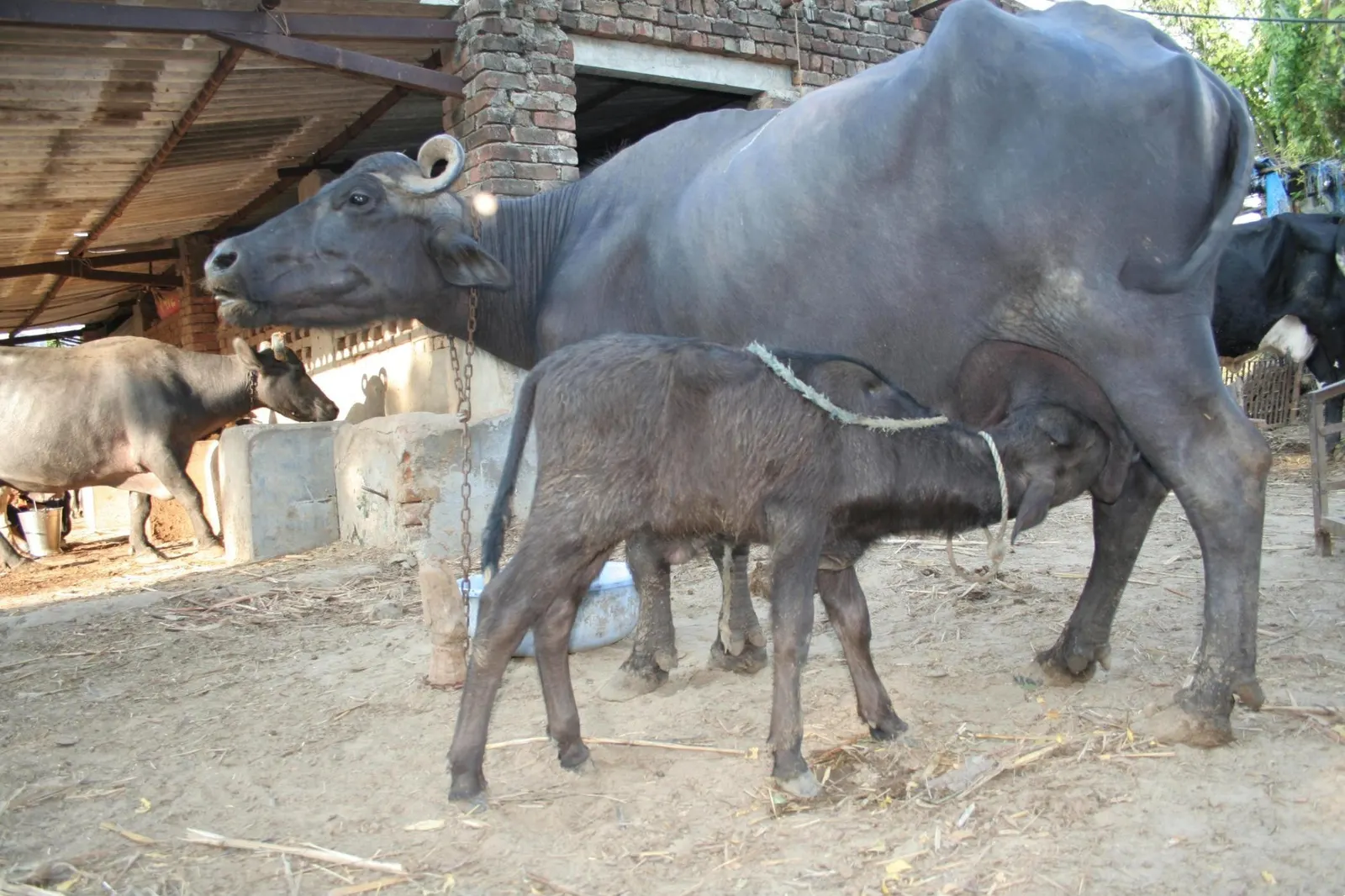
India's main buffalo breeds are Murrah, Jaffarabadi, Mehsana and Surti, with Nili Ravi, Banni, Bhadawari, Nagpuri and Pandharpuri close behind. Murrah is the best known milk breed, at about 1,750 to 1,800 kg per lactation. In ICAR-CIRB records, Banni and Jaffarabadi herds average even more.
Looking for the breeds across the border? Read our guide to buffalo breeds in Pakistan. For cattle, see Indian cow breeds for milk.
How many buffalo breeds are there in India
India has 23 registered buffalo breeds. That is the count on the breed registration page of ICAR-NBAGR, the national bureau that registers livestock breeds, as read in November 2026. The two newest are Melghati from Maharashtra, added in 2025, and Gomanchali from Goa, added in 2026.
Many village buffaloes are crosses or non-descript animals that belong to no registered breed, so a seller's breed name is a claim to check, not a fact.
Which buffalo breed gives the most milk
Murrah is the most widely kept high yielder, but recorded averages for Banni and Jaffarabadi are higher. Sources record milk in kilograms per lactation, which usually lasts about 10 months.
| Breed | Home tract | How to recognise it | Milk per lactation (source) |
|---|---|---|---|
| Murrah | Rohtak, Jind, Hisar, Jhajjar, Fatehabad and Gurgaon in Haryana, and Delhi | Jet black, short horns curled tightly inward | About 1,750 to 1,800 kg (SKUAST Jammu; ICAR-CIRB) |
| Jaffarabadi | Saurashtra, Gujarat, around the Gir forest | Large and heavy, massive head, horns drooping beside the neck then curling up | About 1,620 to 2,239 kg (KAU; ICAR-CIRB) |
| Mehsana | Mehsana, Banaskantha and Sabarkantha, Gujarat | Black or black brown, longer body than Murrah, sickle shaped horns curving up | About 1,200 to 1,620 kg (TNAU; KAU) |
| Surti | Kheda, Vadodara and Anand, Gujarat | Rust brown to silver grey, two white collars at the jaw and brisket, sickle horns | About 1,547 to 1,745 kg (ICAR-CIRB) |
| Nili Ravi | Amritsar, Gurdaspur and Ferozepur, Punjab | Black with white on forehead, muzzle, legs and tail switch, wall eyes | About 1,945 kg (ICAR-CIRB) |
| Banni | Kachchh, Gujarat | Mostly black, upright horns with one or two coils | About 2,857 kg in field herds (ICAR-CIRB) |
| Bhadawari | Agra and Etawah in Uttar Pradesh, near Gwalior in Madhya Pradesh | Copper coloured with sparse hair, two white chevrons on the lower neck | About 1,232 kg (ICAR-CIRB) |
Treat these as herd averages: feed and care matter as much as the breed.
How much milk does a Murrah buffalo give per day
About 6 to 7 kg a day across the whole lactation. Kerala Agricultural University gives 6.0 kg a day and Tamil Nadu Agricultural University gives 6.8 kg. Yield is highest in the weeks after calving: about 15.7 kg on average in recorded Murrah herds, and up to 31.5 kg in the best animals, over a standard 305 day lactation (SKUAST Jammu).
Murrah milk carries about 7 to 7.3 percent fat. When a seller quotes a daily figure, ask whether it is the peak or the average, and watch the buffalo milked morning and evening.
How do you recognise a Murrah buffalo
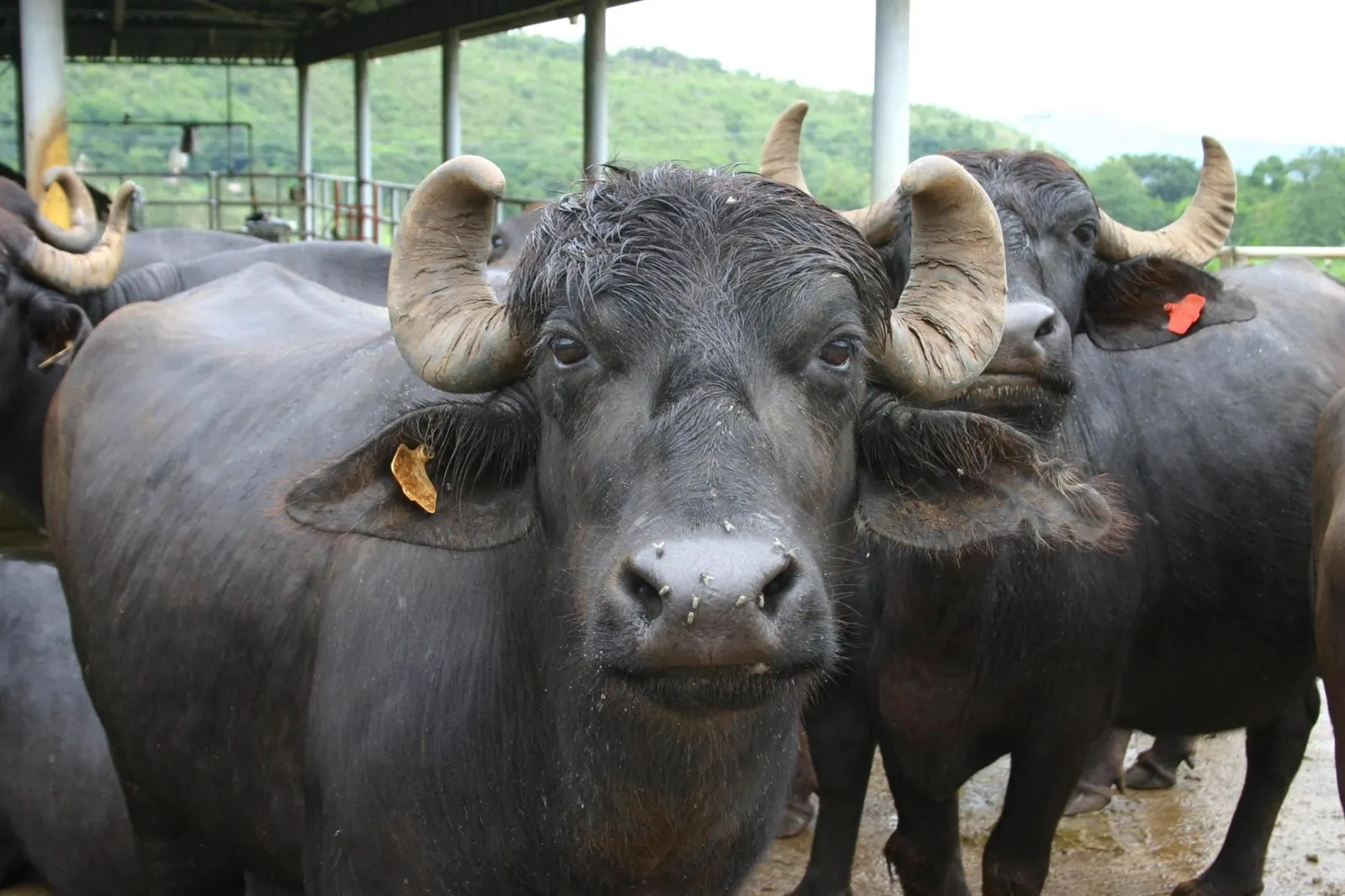
- Coat: jet black, with soft, smooth skin and little hair.
- Horns: short and tight, turning back and up and then curling inward. They loosen a little with age.
- Body: heavy and wedge shaped, with short, strong legs.
- Tail: long, reaching the fetlock, with a black or white switch of up to about 6 inches.
- Udder: well developed, with evenly spaced teats.
Long open horns, brown patches or a light frame point to a cross. Murrah bulls are often crossed with local buffaloes (TNAU names the Godavari buffalo as one such cross), so many "Murrah" buffaloes in markets are graded animals.
How is a Jaffarabadi buffalo different
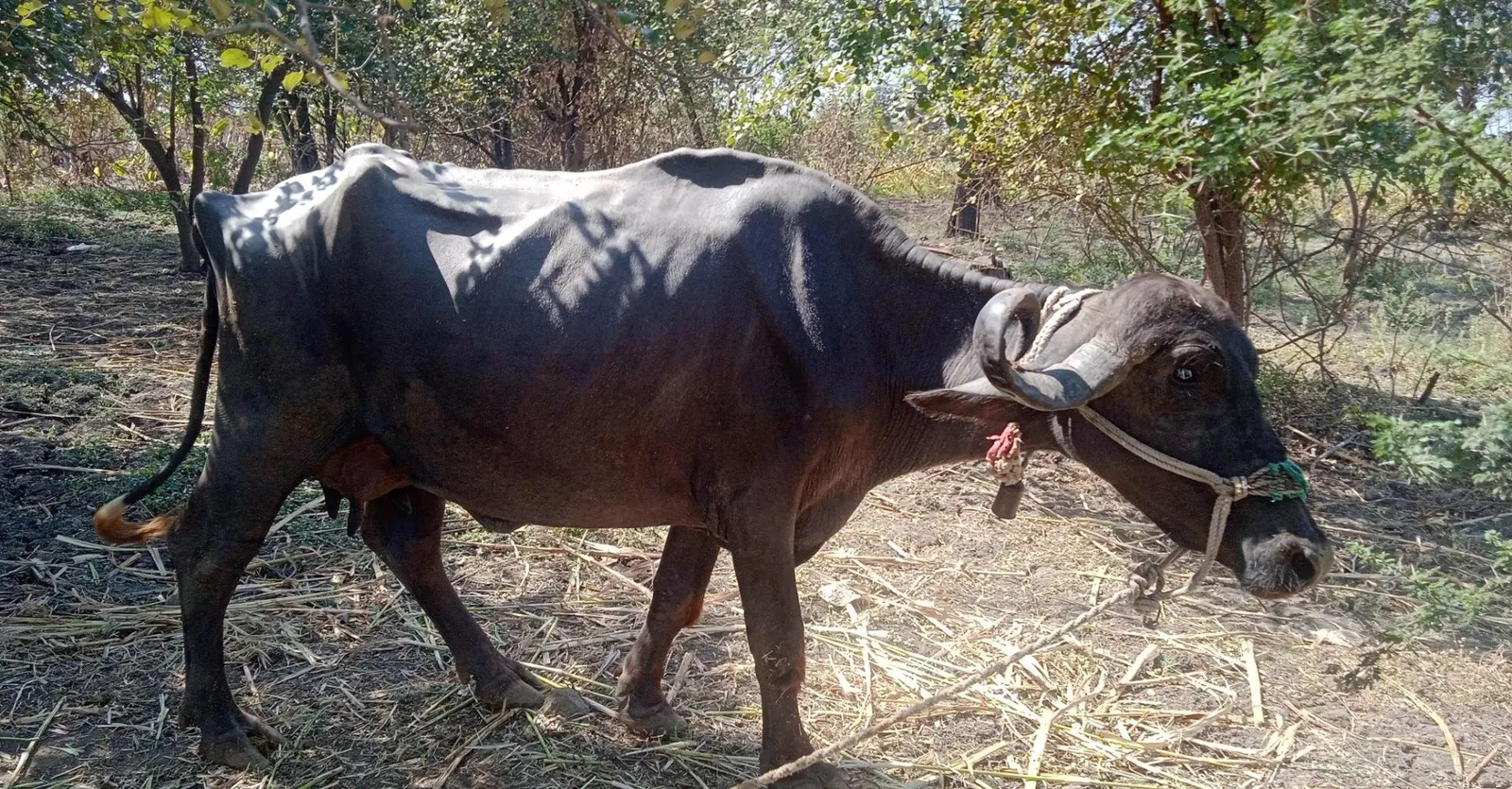
The Jaffarabadi is the heavyweight of Indian buffaloes. It comes from Saurashtra in Gujarat, in districts such as Junagadh, Bhavnagar, Amreli, Jamnagar and Rajkot. Look for a large, massive head and a bulging forehead that partly covers the eyes, giving a sleepy look, especially in bulls. The horns are heavy, droop on each side of the neck and turn up at the tips, in a looser curl than the Murrah's. ICAR-CIRB gives an average fat content of 7.68 percent.
How do you identify Mehsana and Surti buffaloes
Both come from Gujarat and both have sickle shaped horns, so colour and markings matter.
Mehsana buffaloes are black or black brown, with a longer body and lighter legs than the Murrah, prominent bright eyes and horns that curve upward. Yields vary widely: ICAR-CIRB lists 598 to 3,597 kg in 305 days and 5.2 to 9.5 percent fat, so recorded animals are worth seeking out.
Surti buffaloes are medium sized and lighter in colour, from rust brown to silver grey. Look for two white collars, one around the jaw and one at the brisket, white on the forehead, legs and tail switch, and drooping ears fringed with white hair. They give about 4.9 to 5.3 kg a day with about 7.85 to 8.10 percent fat.
Which other Indian buffalo breeds are worth knowing
- Nili Ravi (Punjab) is black with white markings and wall eyes. The breed is shared with Pakistan, and ICAR-CIRB notes that most so called Nili Ravi in Indian Punjab are graded animals.
- Banni (Kachchh, Gujarat) is a hardy breed of the Banni grasslands, mostly black, with an average of about 11.5 kg a day in field records.
- Bhadawari (Yamuna and Chambal ravines) is copper coloured and gives less milk, but with about 8.1 percent fat.
- Nagpuri (Vidarbha, Maharashtra) has long flat horns swept back like a pair of swords, and about 1,038 kg in 305 days.
- Pandharpuri (Solapur, Sangli and Kolhapur) has very long horns running back and up, and about 1,208 kg per lactation.
How should you choose a buffalo breed
Start with the breed that already does well in your area. Then judge the animal, not the label: ask the age, lactation number and calving date, watch two full milkings, check all four teats, and ask for insemination or herd records. A vet check before you pay is worth it.
Browse buffaloes and other animals in our India section, or post a free ad for your own buffalo.
References
- ICAR-NBAGR, Breed registration: 23 registered buffalo breeds. ICAR, 16 new breeds registered (7 August 2026) and Melghati buffalo registered (12 November 2025).
- ICAR-CIRB Buffalopedia: Murrah, Jaffarabadi, Mehsana, Surti, Nili Ravi, Banni, Bhadawari, Nagpuri, Pandharpuri.
- SKUAST Jammu, Murrah buffalo: 1,752 kg in 305 days, peak 15.7 kg a day, best 31.5 kg, 7.3 percent fat.
- Kerala Agricultural University, Buffalo breeds; Tamil Nadu Agricultural University, Breeds of buffaloes.
- NDDB, Indigenous breeds: breeding tracts and main uses.
Frequently asked questions
What are the main buffalo breeds in India?
Murrah from Haryana, Jaffarabadi, Mehsana, Surti and Banni from Gujarat, Nili Ravi from Punjab, Bhadawari from Uttar Pradesh and Madhya Pradesh, and Nagpuri and Pandharpuri from Maharashtra. Murrah is the best known milk breed, and Murrah bulls are widely crossed with local buffaloes.
How many buffalo breeds are there in India?
23 buffalo breeds are registered with ICAR-NBAGR, the national breed registry, as of November 2026. The newest are Melghati from Maharashtra, registered in 2025, and Gomanchali from Goa, registered in 2026. Many village buffaloes are non-descript or crosses and belong to no registered breed.
How much milk does a Murrah buffalo give per day?
About 6 to 7 kg a day on average across the whole lactation, according to Kerala Agricultural University and Tamil Nadu Agricultural University. At peak, recorded Murrah buffaloes average about 15.7 kg a day, and the best have reached 31.5 kg (SKUAST Jammu). A standard lactation is 305 days.
Which buffalo breed gives the most milk in India?
Murrah is the best known high yielder, at about 1,750 to 1,800 kg per lactation in large herds. ICAR-CIRB records show even higher averages for Banni (about 2,857 kg under field conditions) and Jaffarabadi (about 2,239 kg). A single animal's yield depends far more on feed, health and care than on its breed name.
How can I identify a Murrah buffalo?
A pure Murrah is jet black with short horns that turn back and up and then curl tightly inward. It has a wedge shaped body, a long tail reaching the fetlock with a black or white switch, and a well developed udder. Loose, open horns or brown patches suggest a cross.
What is the difference between Murrah and Jaffarabadi buffalo?
Murrah comes from Haryana and has short, tightly curled horns. Jaffarabadi comes from Saurashtra in Gujarat, is larger, and has a massive head with heavy horns that droop beside the neck and curl up at the tips. Its forehead bone often half covers the eyes, giving a sleepy look.
Which Indian buffalo gives the richest milk?
In ICAR-CIRB records, Nagpuri (about 8.2 percent fat), Bhadawari (about 8.1 percent) and Surti (about 7.9 to 8.1 percent) have the highest average fat. Murrah milk has about 7 to 7.3 percent fat.